
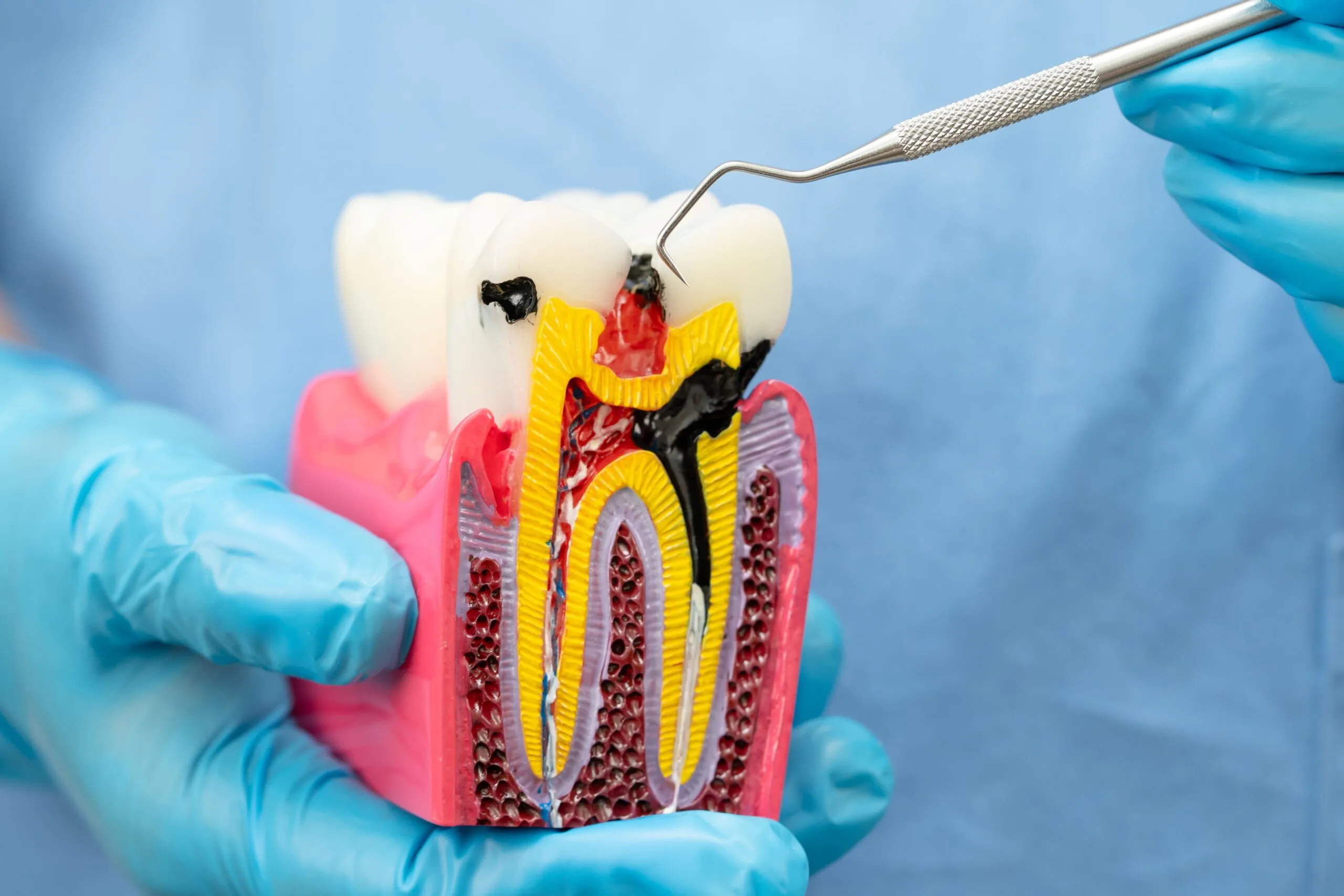
Caries treatment at the Veda Stom clinic (Tashkent) ranges from simple defect closure to complete biomimetic restoration. We use high-strength composites and the latest generation of adhesive systems, allowing us to restore not only the integrity of the enamel but also the functional anatomy of the tooth—the cusps and fissures. This eliminates the risk of secondary caries, restores proper occlusion, and ensures long-lasting results even with deep dentin lesions.
Caries remains the most common oral disease faced by residents of a metropolis like Tashkent. However, the approach to its treatment has undergone fundamental changes in recent years. Modern dentistry views caries not simply as a "hole in the tooth," but as a pathological process requiring meticulous cleaning and precise restoration of the natural tissue architecture. At our Veda Stom clinic, we employ protocols that minimize intervention and maximize the lifespan of teeth.
Why is it important to treat caries in the early stages?
The insidious nature of dental caries lies in its asymptomatic nature in its early stages. By the time a patient begins to experience pain from sweets or temperature stimuli, the process has typically already affected the deep layers of dentin. Our goal in Tashkent is to establish a culture of preventive examinations that allow us to detect enamel demineralization even at the stain stage.
The main risks of untimely treatment:
- The process progresses to pulpitis (inflammation of the nerve);
- Destruction of the subgingival part of the tooth, which makes restoration difficult;
- Reduction in bite height due to destruction of chewing surfaces;
- Risk of infection of adjacent healthy teeth.
Restorative Technologies: More Than Just a Filling
In the past, dentists used materials that simply filled the cavity, often creating a flat surface. Modern restoration in Tashkent This technique involves using materials with a wear resistance and translucency identical to that of a natural tooth. We restore the anatomical ridges and depressions (fissures) necessary for effective chewing and proper distribution of pressure on the jaw joint.
Stages of professional caries treatment:
- Indication of plaque and caries: Use of special markers to clearly distinguish between infected and healthy tissues.
- Minimally invasive preparation: Use of fine-grained burs to preserve the maximum amount of healthy dentin.
- Medicinal treatment: Deep antiseptic cleaning of the cavity to prevent recurrence under the filling.
- Adhesive preparation: Creating a reliable bond between tooth tissue and filling material at the molecular level.
- Layer-by-layer restoration: Application of composite in thin layers, taking into account the optical properties of dentin and enamel.
- Finishing: Grinding and polishing to a mirror shine, which prevents plaque from sticking.
Classification of caries and treatment methods
The choice of treatment method directly depends on the depth of tissue damage. The table below lists the main clinical situations and the therapist's approach.
| Stage of caries | Clinical picture | Treatment method | Expected result |
| Spot stage | A white or dark spot without an enamel defect | Remineralizing Therapy/Infiltration (Icon) | Complete restoration of enamel without drilling |
| Surface | Lesion within the enamel layer | Grinding and installation of micro-filling | Stopping the process, aesthetic restoration |
| Average | The enamel and upper layers of dentin are affected | Classic filling with composite | Restoration of tooth shape and function |
| Deep | Close proximity to the pulp chamber | Therapeutic lining + aesthetic restoration | Maintaining the viability of the "nerve" |
Durability and aesthetics at Veda Stom
Many patients in Tashkent ask, "How long will a modern restoration last?" With proper isolation protocols (using a rubber dam) and proper home care, the lifespan of the latest generation of light-sensitive fillings is over 10 years. We use materials with a "chameleon effect" that adapt to the color of the surrounding tissue, making the boundary between the tooth and the filling completely invisible.
Advantages of treatment in our clinic:
- Use of biocompatible materials that do not cause allergies;
- High precision of material fit, eliminating leakage and secondary infection;
- Completely painless thanks to modern methods of local anesthesia;
- Restoring natural chewing function.
The health of your smile is an investment in your overall quality of life. Treatment at Veda Stom not only eliminates the current problem but also prevents complex dental procedures in the future.